Posts

The Ladies of the Vale

Image
We've now 'arrived' in Lichfield where on Christmas Day 700 the consecration of the first cathedral here took place and, as there was a church (St Mary's) here perhaps built in 659, and possibly others in between, Lichfield is among the earliest centres of Christian worship in the UK. After the invasion of 1066 the Normans built a new cathedral (of which only a few traces remain), and a century or so later that was rebuilt in the Gothic style, and completed by c.1340.  Besieged three times in the Civil War, it suffered drastic damage, more than any other cathedral. Rapidly repaired in a mere nine years, its interior was rearranged at the end of the 18th century, and then further 'restored' in the 19th century by Sir George Gilbert Scott, and his son Oldrid - that is the cathedral you see in Lichfield today. Outside statues were replaced on the West Front with over 160 ornate carved figures of kings, queens and saints. The cathedral's interior was refurbishe...

A story of destruction and rebirth

Image
The next 'stop' we've reached on our journey is Coventry . There have been three cathedrals in the city of Coventry. The first building, St Mary's Priory and Cathedral was built between 1095 and 1102. This lasted until 1539 when it was the only medieval cathedral to be demolished by Henry VIII's dissolution of the monasteries. The second building, St Michael's Church, had been constructed in the late 14th and early 15th centuries. It was originally a parish church bur was elevated to cathedral status in 1918. On the night of 14th November 1940, a German raid over the city of Coventry destroyed the medieval Parish Church Cathedral of St Michael along with factories and over 4,000 houses. 568 people died in the attack. The decision to rebuild the cathedral was taken the day after its destruction, but it was not until 1951 that a competition was held for the design of a new cathedral. There were 219 entries and the design chosen was by Basil Spence. His design was ...

Famed Fragments from the past

Image
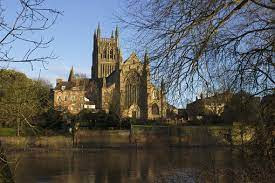
Our concerted efforts have brought us to Worcester , where the present Cathedral Church of Christ and our Lady dates from the 13th century, but there has been a religious foundation here since the 7th century. A Norman Cathedral was built in the 11th century but only the crypt remains. It was the burial place of King John (of Magna Carta fame), who had stipulated in his will that he wanted to be buried in the cathedral between St. Wulfstan and St. Oswald. This will, incidentally, is the oldest surviving will of a British monarch and is kept in the cathedral to this day. In the later Middle Ages the cathedral priory was noted for its already-established tradition of Roman chant, and a notable collection of over 100 anonymous pieces of church music from the 13th and 14th centuries has become known as the ' Worcester polyphony ' since all indications point to its being assembled by monks at the cathedral. Following a dissolution of the monasteries in the 1530s the cathedral-priory...

Medieval Manuscripts and a Famous World Map

Image
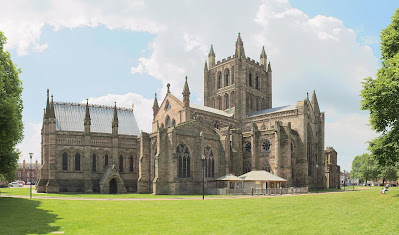
  We've arrived at Hereford Cathedral, which includes some fine examples of architecture, from its Norman origins to the 20th century New Library building, with features such as four magnificent stained glass windows, a Romanesque Nave and the restored Shrine of St Thomas of Herford. It is home to two great treasures, the Hereford Mappa Mundi and the Chained Library. The Library is the largest surviving chained library in the world, containing about 1,500 books, dating from the 8th to early 19th centuries including many medieval manuscripts. The Mappa Mundi is one of the most celebrated medieval maps still in existence and, at over 5 feet by 4 feet, is the largest to survive. While the image may look confusing at first glance, a simple diagram can de-mystify this and its Biblical origins. It is known as a 'T and O' map. Centred on Jerusalem, the stem of the T is the Mediterranean Sea with the Rivers Don and Nile making its crossbar. This divides the World into three conti...

Pottering around with hidden haloes in Gloucester

Image
Gloucester Cathedral , formally the Cathedral of St. Peter and the Holy and Invisible Trinity, stands in the north of the city near the River Severn. It was built in 678 with the foundations of an abbey dedicated to St. Peter: later to be dissolved by Henry III. The cathedral consists of a Norman nave with additions in every style of Gothic architecture. It is 420' long, 144' wide with a fine 16th century central tower rising to 225' topped by 4 pinnacles that are considered to be a local landmark. The crypt, nave and chapter-house date from the 11th century; the crypt being one of four apsidal cathedral crypts in England with the others in Worcester, Winchester and Canterbury. The nave was begun in 1089 and the church largely completed by 1100. In the early 12th century, the western towers were added following the collapse of the south tower in1165. In 1222, a fire damaged the timber roof of the monastic buildings. To repair the damage, and update the architectural style, ...

Musical memories from the heart of London

Image
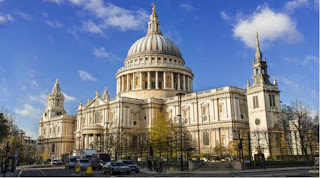
 Three days in and we'd clocked up the 55.3 miles required to take us to St. Paul's. Here's a little piece about our most recent stop by our Director of Music, Derek Clark. St Paul's is London's Cathedral, being the seat of the Bishop of London. The present building, the masterpiece of the architect Sir Christopher Wren, dates from the 1670s and is the fifth church dedicated to St Paul to be built on this site (the first dated from 674AD). All four of the previous buildings were destroyed by fire - indeed, it was as a result of the general rebuilding following the Great Fire of London in 1666 that Wren was awarded the commission for a new cathedral. All that remains of any of the older buildings is a memorial effigy (now situated in the South Choir Aisle) of the English poet and mystic John Donne, who was Dean of the cathedral from 1621 until his death ten years later. The most conspicuous part of the building is of course the Dome, which still dominates the London ...

A little spring in our steps...

Image
Although with possibly not much sun to enjoy there were still 'tree-mendously' beautiful sights to behold in our home town as we increased our step counts today. Signs of Spring are all around us with the trees bursting in new life. Helensburgh is renowned for its spectacular cherry blossom trees which grace the majority of streets in our town and early May is the best time to see them in all their glory. A walk from the far west to the far east along many of the residential streets that run parallel to the sea front will afford you a view of their stunning display. Although, you'll need to be quick as their fragile blossoms could well fall with the wind and rain forecast for tomorrow!